Ten years ago, brands fought for a spot on the first page of search results. Five years ago, they fought for a place in the social feed. In 2026, the battleground has moved inside the AI answer — when a buyer asks an AI “which vendor should I use,” the brand that gets named first, and described favorably, wins the starting line of the mindshare race.
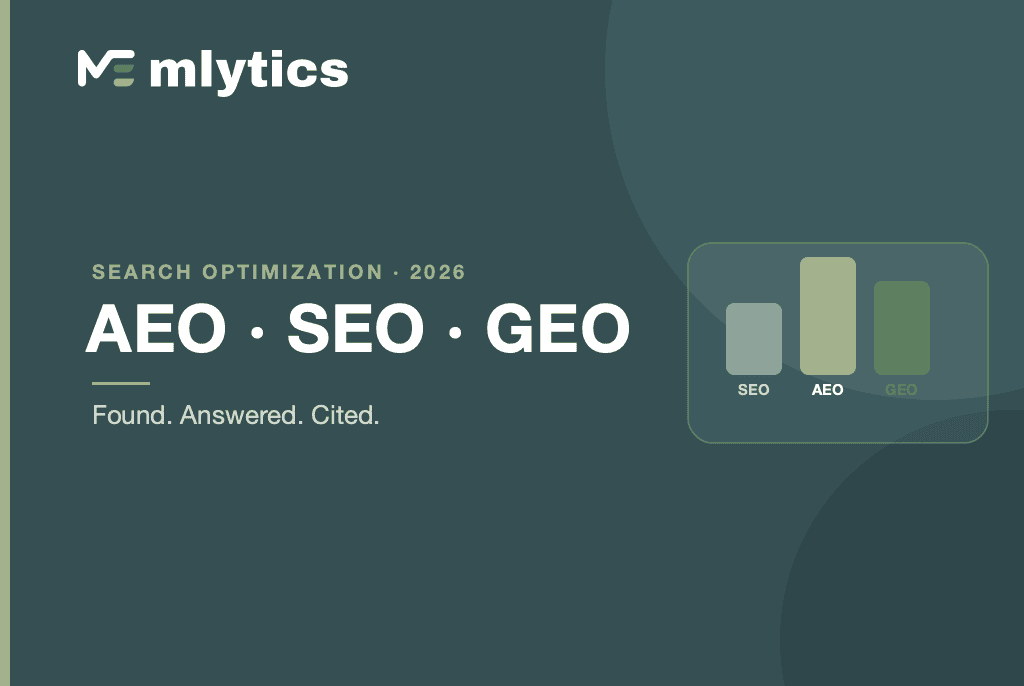
SEO (Search Engine Optimization) aims to rank your pages high in search results and earn the click. AEO (Answer Engine Optimization) aims to make your content the answer an AI gives directly. GEO (Generative Engine Optimization) aims to make you a cited source when an AI generates a long-form response. The three compete on entirely different logic: SEO competes for ranking positions, AEO competes for the single answer slot, and GEO competes for a place in the AI’s pool of cited sources.
Here is the reality of 2026: 94% of B2B buyers used AI tools for research in their most recent purchase — yet only 22% of marketing teams track how visible their brand is inside AI answers. That gap is the blind spot this article is here to close.
AEO, SEO, GEO — what’s the difference, in one table?
In one line: SEO gets you found, AEO gets you answered, GEO gets you cited.
| SEO | AEO | GEO | |
| Full name | Search Engine Optimization | Answer Engine Optimization | Generative Engine Optimization |
| Goal | Search rankings and clicks | Become the answer AI gives directly | Become a cited source in AI-generated responses |
| Main arena | Google and Bing results pages | AI Overviews, featured snippets, voice assistants | ChatGPT, Perplexity, Gemini, Claude |
| Success metric | Rankings, organic traffic, CTR | Answer exposure, extraction frequency | Citation rate, mention rate |
| User behavior | Type keywords, browse multiple results | Ask a question, get one answer | Delegate a task, get a complete output |
| Competition | Ten blue links fighting for the top three | One answer slot, winner takes all | A handful of sources make the citation pool |
The three are not replacements for each other — they are three entrances to the same funnel, on different interfaces. That matters when you decide “which one first” below.
How did search behavior evolve from the 2010s to 2026?
Search behavior has shifted in three stages: from finding links, to demanding answers, to delegating tasks.
- 2010s — finding links: Users typed keywords and did their own comparing, filtering, and clicking across ten blue links. Traffic was the universal currency, and SEO was the only game in town.
- 2022 — demanding answers: ChatGPT arrived, and users discovered they could simply ask a question and get an answer without opening ten tabs. Google responded by putting answers directly on the results page with featured snippets and AI Overviews.
- 2026 — delegating tasks: Users no longer just ask “what is AEO.” They say “compare three vendors and recommend one.” The AI doesn’t just answer — it performs the research, comparison, and decision process on the user’s behalf.
The data shows the scale of the shift: in the first half of 2026, more than 68% of Google searches ended without a single click (Similarweb) — most queries are satisfied right on the results page. And in B2B purchasing, buyers now rate AI as a more meaningful research source than vendor websites or sales reps.
Is SEO still relevant in 2026? What does Google itself say?
Yes — and Google’s position is that AEO and GEO are simply part of SEO. This is the part most articles won’t tell you: in May 2026, Google publicly stated that AEO, GEO, LLMO and the rest of the new acronyms all describe practices that fall within SEO — not separate disciplines — and that tactics like llms.txt or special content chunking are not necessary for Google’s own AI search features.
We think this statement deserves to be taken seriously rather than argued around. It reveals two things:
First, the vocabulary is still evolving — don’t bet your budget on a name. What’s called AEO today may be called something else tomorrow; the industry still has no consensus definition for any of these terms.
Second, the underlying logic has never changed: write content that is clear, specific, and true. However AI systems evolve, their preferences for answers and citations stay consistent — content that answers the question directly, content with data and sources, content machines can parse. Which happens to be the definition of good SEO for the past twenty years.
So the right question isn’t “is SEO dead?” It’s: does your content strategy serve all three moments — being found, being answered, being cited? The three share one set of content fundamentals; they differ only in distribution and structural detail.
How does AI describe your brand right now? We ran the test on ourselves
Before writing this article, we did something slightly masochistic: we opened five mainstream AI platforms (ChatGPT, Perplexity, Gemini, Claude) and asked each the same question — “Tell me about Mlytics.”
All five had an answer. But all five described the business we ran five years ago: Multi-CDN, website acceleration, smart load balancing. The products we have spent the last two years building did not appear in a single word.
The second round was more interesting. When we changed the question from our brand name to what a buyer would actually ask — “What tools can help a brand appear in AI answers?” — Mlytics didn’t even get a mention. The answer was a list of other companies’ names.
Two observations from that exercise apply to every brand reading this:
- AI’s picture of you lags reality. It describes the version of you that has been written about the most — usually the you of three to five years ago. If you don’t refresh the narrative about your brand across the web, AI keeps you frozen in the past.
- Brand-name visibility is an illusion. Being able to answer “tell me about brand X” means little. Buyers doing purchase research ask “what tools solve problem Y” — whether you show up in those market-scenario queries is the real battleground.
Which one should I do first? Three “from X to Y” shifts
Rather than picking one of three acronyms, watch the three shifts that are actually happening, and put your effort where things are moving:
- From “what do we rank” to “are we in the answer” — keyword rankings are a stock metric; AI citation is a flow metric. Your dashboard needs the second one.
- From generic brand exposure to scenario-based intent placement — AI doesn’t recommend “good tools.” It recommends answers to specific scenarios (“how should a SaaS brand approach AEO,” “new revenue for publishers in the zero-click era”). Brands don’t need to be louder; they need to be caught precisely where buyers actually ask.
- From exposure counts to confirmed intent — this is the division of labor between Mlytics Cortex and monitoring tools: monitoring tools tell you how many times you were mentioned; Cortex makes the mentions happen, then turns them into signal — brand-relevant questions and links are placed beneath publisher content, and the moment a reader finishes the piece and actively clicks in, that is a purchase intent confirmed on the spot. What the brand receives is not a reach report, but individual readers who have genuinely expressed interest.
If you remember one thing: the center of gravity is moving from “where do we rank” to “were we cited — and did we catch what came after.” The measurement playbook for the former is twenty years mature. The latter is just beginning.
FAQ
- Do SEO, AEO, and GEO need three separate teams? No. All three share the same content fundamentals — direct answers, clean structure, cited sources. They differ in distribution and measurement. Teaching your existing content team answer-oriented writing, then layering in citation tracking, beats building three org charts.
- With a limited budget, what should we invest in first in 2026? Make your content quotable first: rewrite your ten most important pages to answer questions directly, and make sure your brand is described consistently across every platform. This one step serves all three goals, costs the least, and you will never regret it.
- Google says AEO/GEO are just SEO — can I ignore the new terms? You can ignore the terms. You cannot ignore the behavior shift: your buyers are already researching with AI. Planning content around “users research products inside AI” as a fact is more productive than debating taxonomy.
- How do I find out my current visibility in AI answers? Take a set of questions your buyers actually ask (like “what tools can do X”), put them to ChatGPT, Perplexity, and Gemini, and record how often your brand appears. That’s your baseline.
How does AI describe your brand today — the current you, or the you of five years ago? We ran the test on ourselves, and the answer was humbling. But knowing the humbling answer is the first step to taking back your place in the AI answer. Mlytics Cortex puts your brand inside the content buyers trust, and captures and verifies intent the moment a reader expresses it.